
Championing Human Rights: How the Sports Industry Drives Everyday Change
Each year on December 10, the United Nations observes Human Rights Day, honoring the 1948 adoption of the Universal Declaration of Human Rights (UDHR). More than an annual milestone, this day is a global reminder for action. The work of building a world where human rights are universally respected is ongoing. Organizations play an increasingly vital role in this effort, and the sports industry stands out as a sector with enormous opportunity—and responsibility—to lead.
This year’s Human Rights Day theme, “Human Rights: Our Everyday Essentials,” reminds us that human rights are not lofty ideals but daily necessities. In the sports industry, this becomes clear when business decisions made in boardrooms shape what happens on the field, in stadiums, and across event supply chains.
The Evolution of Human Rights in Commerce and Sports
The UDHR established core freedoms and protections for all. Over time, these values have shaped not only public policy but also the expectations of the private sector, including global sports organizations, teams, and sponsors. Today, businesses in sports are recognized as powerful influencers whose everyday decisions—about fair pay for workers building new stadiums, equitable treatment of athletes, or access for underrepresented fans—directly impact human rights around the world. The choices made by sports businesses ripple far beyond the field or arena, affecting the entire value chain, from local communities, to suppliers, and global audiences.
Since the 2011 endorsement by the UN Human Rights Council of the United Nations Guiding Principles on Business and Human Rights (UNGPs), companies—including those in sports—are expected to prevent and address human rights harms associated with their activities and relationships. The UNGPs are now integral to international standards, national action plans, and Environmental, Social, and Governance (ESG) frameworks and regulations, including the EU’s Corporate Sustainability Due Diligence Directive (CSDDD). Compliance with these principles is becoming a non-negotiable aspect of hosting tournaments, building venues, and managing sponsorships.
Despite growing awareness, the sports sector, like many others, continues to struggle with the gap between policy and everyday practice. Traditional compliance methods, such as standard audits, often fail to address complex, context-specific issues, including, for example, the displacement of vulnerable communities to make space for event venues, the treatment of migrant workers building those venues, athlete or fan discrimination, or forced labor in the supply chains of major events. These examples are a few of many that highlight how, for many involved in the sports ecosystem, the promise of human rights remains unfulfilled.
Case Studies: Houston and Dallas 2026 Local Organizing Committees
These challenges can be addressed head on, and with thoughtful planning, robust stakeholder engagement, and effective oversight, the sports industry can become a model for rights-respecting practice. Next summer, the FIFA World Cup 26™ comes to North America, where the world’s largest sporting event to date will take place, with cities in Canada, Mexico, and the United States co-hosting the games. In fulfilling the new human rights requirements laid out by FIFA World Cup 26™, two Texas local organizing committees, in Houston and Dallas, provide a clear vision for stakeholder engagement to prevent human rights abuses.
From the start, human rights considerations were a priority. In the bid phase itself, and later in partnership with Henekom Group, Houston and Dallas developed human rights impact assessments to ensure comprehensive due diligence would be built into the process at the earliest stage. Convening more than 400 stakeholders in just four months—civil society, rights advocates, unions, workers, government officials, and sponsors—these cities worked to build consensus on human rights risks linked to hosting, co-created mitigation strategies, and built detailed human rights action plans, ensuring overall readiness.
A comprehensive landscape analysis in both host cities uncovered critical risks: low unionization, inadequate minimum wages, and elevated worker injury rates. In response, the local organizing committees, through a collaborative effort, produced a Responsible Contracting Policy to address many of these gaps. Both committees embedded worker safeguarding principles into their Requests For Proposals, vendor evaluations, and contract terms. To operationalize this commitment, an automated bid management system now streamlines oversight and ensures accountability across procurement.
In another example, the Houston Host committee identified the need to improve accessibility for fans with disabilities and organized a “disability ride-along” with the local transportation agency and community members with disabilities. In essence, it was a trial run—led by individuals with disabilities—to experience what taking public transit to the games would be like. The exercise generated practical recommendations for making public transit more accessible and user-friendly.
5 Key Take-Aways from Houston & Dallas Case Studies:
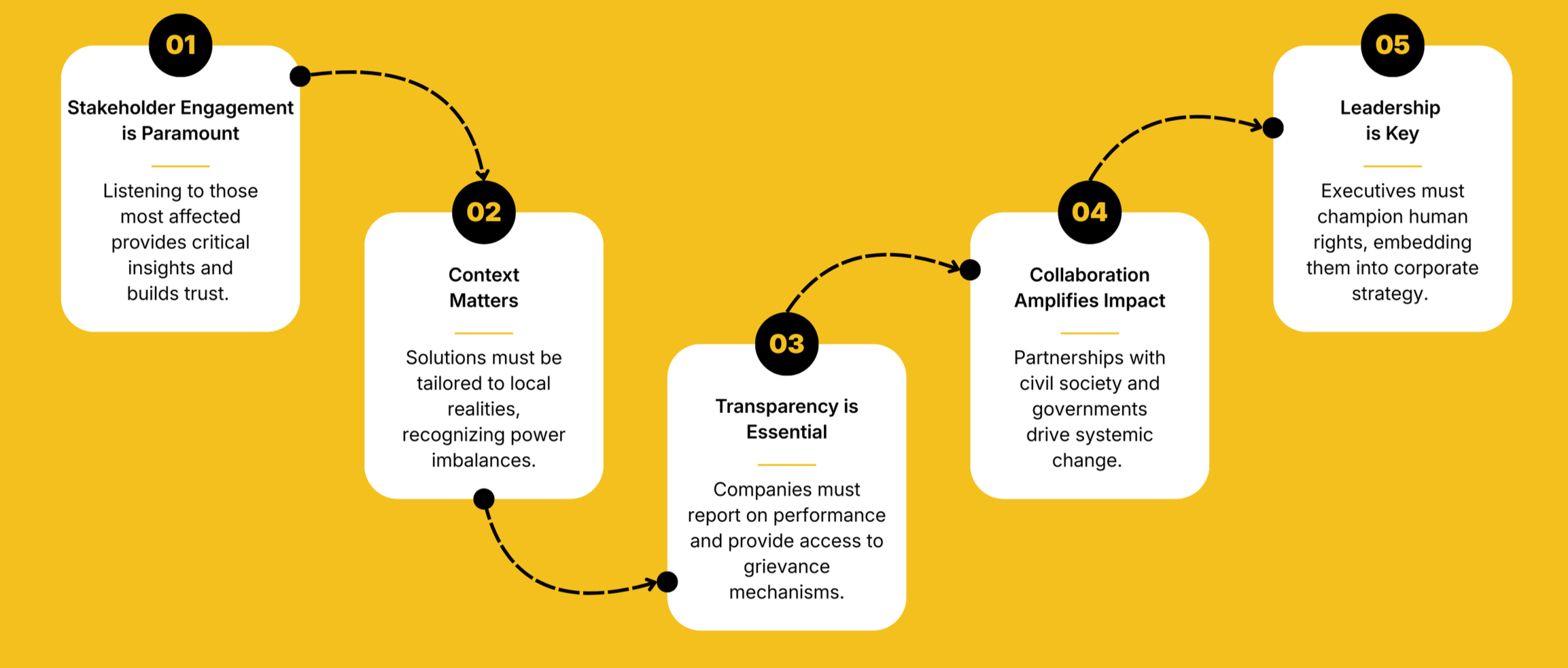
First, stakeholder engagement is paramount. Listening to those most affected by business operations provides critical insights and builds trust.
Second, context matters. Solutions must be tailored to local realities, recognizing power imbalances and fostering participation.
Third, transparency and accountability are essential. Companies must report on their human rights performance, provide access to grievance mechanisms, and respond to concerns in real time.
Fourth, collaboration across sectors amplifies impact. Partnerships with civil society, governments, and industry peers can drive systemic change and raise standards across entire markets.
Fifth, leadership is key. Business executives must champion human rights from the top, embedding them into corporate strategy and culture—and across business functions. This requires ongoing education, investment, and a willingness to challenge entrenched practices.
The UN Guiding Principles informed the human rights requirements laid out for host cities. The local organizing committees in Houston and Dallas, with intensive stakeholder engagement, localized the principles. And now, in the lead up to the 2026 summer games, individuals on the ground are turning those principles into practice. These efforts combined show that effective human rights due diligence in sports is possible and will lead to a better experience for all involved in both the preparation of the games and how fans experience them.
The Business Case for Human Rights in Sports
Globally, sports are celebrated as sources of joy and community—but behind the spectacle is a vast commercial ecosystem, estimated to reach $602 billion by 2030. This industry is shaped by complex supply chains, rapid construction, fragmented labor markets, and intricate governance structures.
For fans, attending or watching a major sport live may feel like an “everyday essential”—a moment of connection and excitement. Yet, for many individuals involved in delivering these experiences, the reality can be starkly different. Mega-events have been plagued by labor exploitation, forced displacement, police surveillance, and suppression of civil liberties. The erosion of freedom of the press and limits on individual expression have also cast shadows on the integrity of sports events.
Embedding human rights in the sports industry is essential for legal compliance, financial performance, and brand reputation. It is also the right thing to do. Governments are enacting tougher due diligence and transparency laws, and sports organizations that fall short risk legal action, exclusion from hosting opportunities, or loss of sponsorship. Investors and fans are increasingly demanding ethical conduct, and attention on human rights abuses can inflict lasting damage on sports brands.
One of the most promising developments in business and human rights is a shift away from “one-size-fits-all” compliance models toward approaches that center those most affected by corporate operations. The UNGPs advocate for meaningful stakeholder engagement, local context, and participatory decision-making. This requires businesses to move beyond audits and checklists, investing time and resources in understanding the lived experiences of workers, communities, and other stakeholders. As we move into a future of greater awareness about the realities of human rights in sport, the business of sports must move toward deeper engagement with affected groups to drive real change.
By listening to those on the front lines, sports organizations, local governments, and companies can identify risks early, develop tailored interventions, and build lasting solutions. This approach not only aligns with international expectations but also enhances business resilience and reputation. It demands leadership, creativity, and a willingness to embrace new ways of working, but the rewards are significant.
Looking Ahead: Embedding Human Rights into the DNA of Sports Business
As regulations tighten and expectations rise, sports businesses must lead the way in embedding human rights into their DNA. This means integrating responsible practices from strategy to operations and making respect for human rights a non-negotiable part of every sporting event, partnership, and business decision.
When the sports world treats human rights as everyday essentials, it not only prevents harm but also strengthens the integrity and spirit of competition, reinforces community bonds, and sets an example for other industries.
By moving from policy to action, centering affected stakeholders, and embracing transparency, the sports sector can build resilient, ethical organizations ready for the future. Human rights are our “everyday essentials”—and embedding them in sports business is key to creating a more just, inclusive, and sustainable future for all.
The authors would like to thank Bridget Montovani for her contributions.
About Henekom Group
The Henekom Group is a consultancy that specializes in human rights and sustainability due diligence for major sporting events. Distinct in the field for our emphasis on execution and measurable results, Henekom Group can advise bid and host cities and nations on human rights due diligence. Henekom Group and the content of this article are independent of, and not affiliated with, endorsed by, or sponsored by entities referenced herein.
If you’d like to learn more about how we can support your city or organization, please fill out our contact form and follow us on LinkedIn to stay connected.